Short answer: no. If you can feed hay today, you can feed cubes tomorrow. Here’s the longer answer.
The myth
Switching to cubes means buying grinders, soaking tanks, and special feeders.
The reality
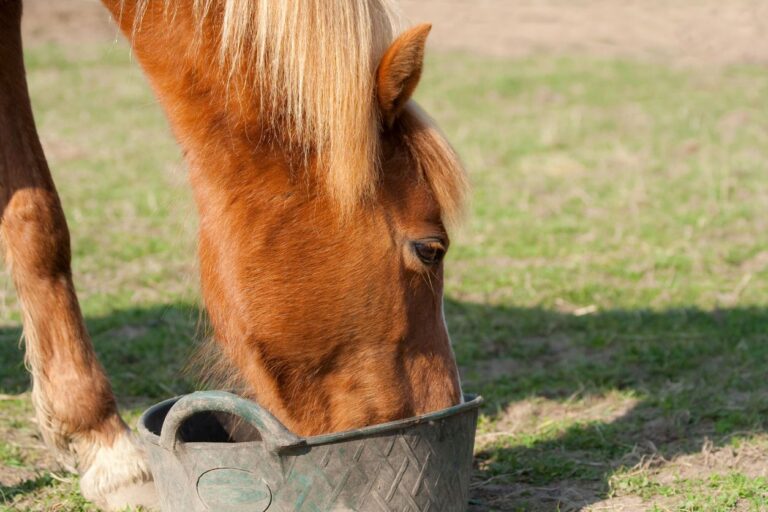
A feed pan and a water source. That’s the whole setup.
Where the myth comes from
Cubes look processed. They’re compressed, uniform, and they come off a manufacturing line — so people assume there must be machinery on the other end too. There isn’t. The compression happens at our facility so it doesn’t have to happen at yours.
The other source of confusion is mixing cubes up with commercial feed operations, where trucks and augers and mixers are part of the picture. That’s a scale thing, not a cube thing.
What you actually need
- A feed pan, bucket, or manger. Whatever you already use.
- Water. Fresh and available, same as always — plus a little extra if you soak.
- Dry storage. Off the ground, out of the weather, decent airflow.
That’s the list. No grinder, no hammer, no specialty feeder, no equipment purchase to make the switch.
Feeding dry
Most horses eat cubes dry without any trouble. They chew them down the same way they’d work through a flake of hay. Keep water in front of them and let them eat.
When to soak
Soaking is a choice, not a requirement. It’s worth doing for:
- Seniors and horses with worn or missing teeth — softened cubes are easier to chew.
- Horses that bolt their feed — slowing intake reduces choke risk. Talk to your vet about any horse with a history of choking.
- Hot weather — soaked cubes are an easy way to get more water into a horse that isn’t drinking enough.
Warm water speeds it up; most cubes break down in about 15 to 30 minutes. In summer heat, feed soaked cubes promptly rather than letting them sit out. A bucket and a hose is the entire soaking system.
Storage doesn’t change either
Cubes come in super sacks or 50lb bags, so you can match your order to how your barn already moves feed. If you’ve got a forklift and a covered pad, super sacks make sense. If your crew stacks by hand, take the bags. Either way it goes in the same feed room your hay does — dry, off the ground, with air moving through.
Five horses or fifty
The answer holds at scale. A boarding facility feeding fifty head doesn’t need different equipment than a private barn feeding five — just more pans and a bigger order. That’s the part that surprises people: the operational lift of switching to cubes is close to zero.
Ready to make the switch?
We’ve been manufacturing alfalfa cubes in Southern California for over 50 years, and we sell direct — no distributor in the middle. Premium Alfalfa Cubes are 100% alfalfa. Preferred Protein Cubes are 50% alfalfa and 50% wheat straw. Two-pallet minimum, free delivery throughout Southern California.